Shopify vs Common Ground for Record Stores
If you run a record store, choosing the right platform is one of the most important decisions you can make. It affects how easily customers browse your catalog, how smooth your mobile experience is, how you manage inventory, and how much control you keep over your brand.
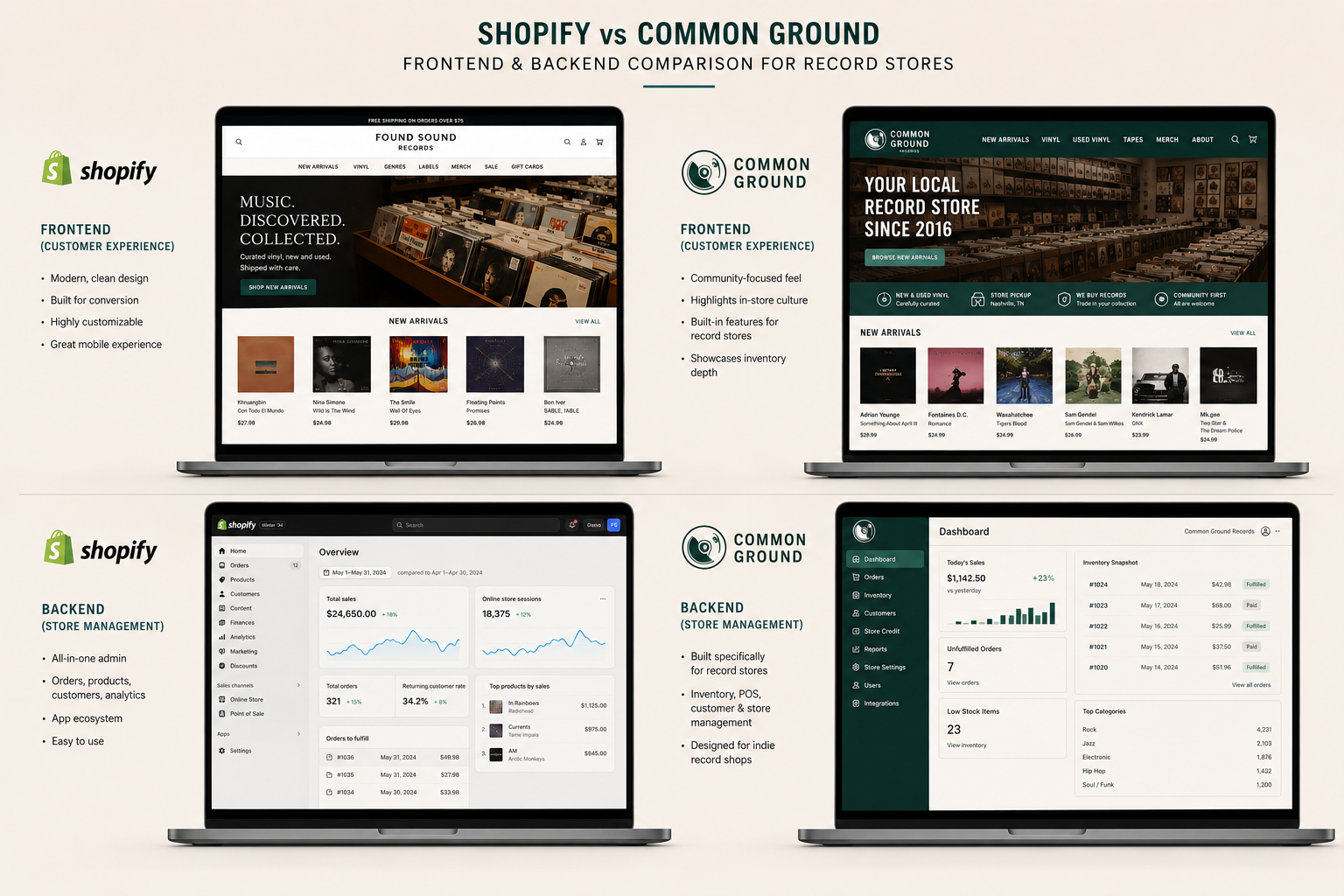
The short version is this: Shopify is often the better choice for record stores that want long-term flexibility, a polished storefront, and a platform they can grow with. Common Ground is interesting for shops that want a music-specific system, but Shopify gives most stores more room to build a stronger business over time.
Why this comparison matters
Record stores are not normal ecommerce businesses. You often deal with used stock, grading, one-off items, Discogs workflows, in-store and online sales at the same time, and customers who care about browsing by genre, condition, rarity, and format.
That means the platform should not just look nice. It should help you handle real operational complexity without creating more manual work.
Shopify in practice
Shopify is the strongest all-round option for many record stores because it gives you a polished storefront, strong mobile performance, a large ecosystem of apps, and full control over design.
It is especially useful if you want to:
Build a stronger brand around your shop.
Create a better customer experience.
Improve mobile conversion.
Connect multiple tools and workflows.
Grow beyond a basic ecommerce setup.
In practice, Shopify is often the platform that gives store owners the most options later, even if it takes a bit more setup at the start.
Common Ground in practice
Common Ground is more niche and music-focused. That can be a real advantage if you want a system designed around record-store logic rather than a broad ecommerce platform.
It is especially appealing if you care about:
Music-retail workflows.
A system built specifically for record shops.
Less need to stitch together separate tools.
A setup that feels closer to your industry.
The downside is that a niche platform can be more limited in flexibility, branding freedom, or broader ecommerce customization compared with Shopify.
POS and in-store sales
Both Shopify and Common Ground support POS and in-store selling. The real difference is not whether POS exists, but how the platform fits the rest of the store’s workflow, branding, and long-term growth strategy.
Price comparison
Cost is one of the biggest differences between the platforms.
Common Ground presents itself as an all-in-one record-store platform with an Essentials plan starting at $30/month and no platform fees. Shopify’s base plans are also affordable, but the total cost can increase once you add apps, themes, payment processing, or custom setup.
For many record stores, that is not really a downside — it is the price of getting a platform that can be shaped more precisely to the brand and the customer experience.
Which one is better?
For most record stores, I would say Shopify is the better default choice.
Why? Because most shops eventually want:
better branding,
stronger online sales,
easier marketing,
more control over the site,
and a platform that can evolve with them.
Common Ground makes sense if a store wants a very specific record-store workflow and is happy with a narrower system. But if you are trying to build a serious long-term ecommerce presence, Shopify usually gives you more room to grow.
When Common Ground is the better choice
Common Ground can be a strong option if the store:
has a very music-specific operation,
wants a tightly focused system,
does not need extensive customization,
and prefers a platform built around the record-store business model.
In other words, it can work well for stores that want simplicity and niche alignment over flexibility.
When Shopify is the better choice
Shopify is the better choice if the store:
wants a better-looking storefront,
needs more conversion potential,
wants to sell internationally,
needs more control over design,
or wants to build a real brand instead of just a functional shop.
It is also usually the better option if you want the site to support content, SEO, and future marketing efforts.
My recommendation for record stores
If I were advising a record store owner, I would usually start with Shopify.
Why? Because most shops eventually want:
better branding,
stronger online sales,
easier marketing,
more control over the site,
and a platform that can evolve with them.
Common Ground is worth considering when a shop wants a very specific record-store workflow and prefers a narrower system. But for most stores that want room to grow, Shopify is the more future-proof choice.
Final thought
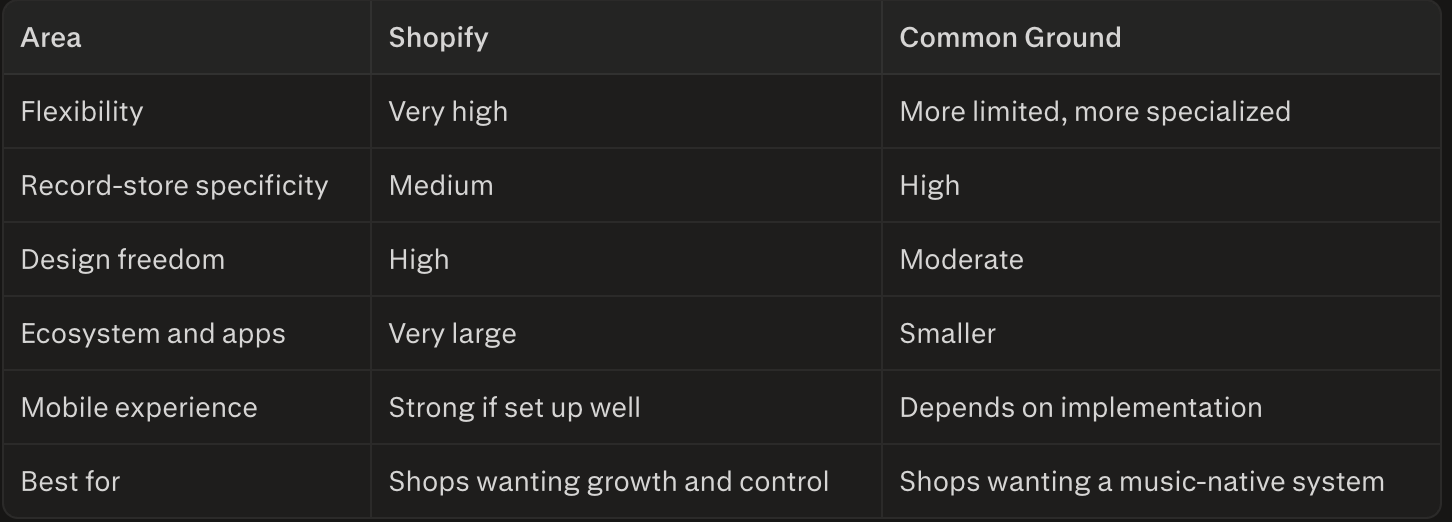
This is not really a battle between two equal options. It is a choice between flexibility and specialization. For many record stores, Shopify wins because it can be shaped into a strong, modern, branded sales system. Common Ground wins when the shop wants a more focused record-store environment and less general ecommerce complexity.
If your record store is on the wrong platform, or your current setup feels outdated, we can help you review it and show you what to improve first.
PRYMAL Digital
Shopify webshops built for record stores.
Built for discovery, collectors, and modern vinyl commerce.