Discogs to Shopify: How Record Stores Can Sync Inventory Better
Many record stores already use Discogs in some way. It is useful for listing used stock, checking market prices, and reaching collectors who already spend time on the platform.
The problem is that Discogs usually does not solve the whole online sales workflow. Once a store also wants a branded storefront, better promotions, and a smoother customer experience, things can get messy fast. That is where Shopify becomes useful.
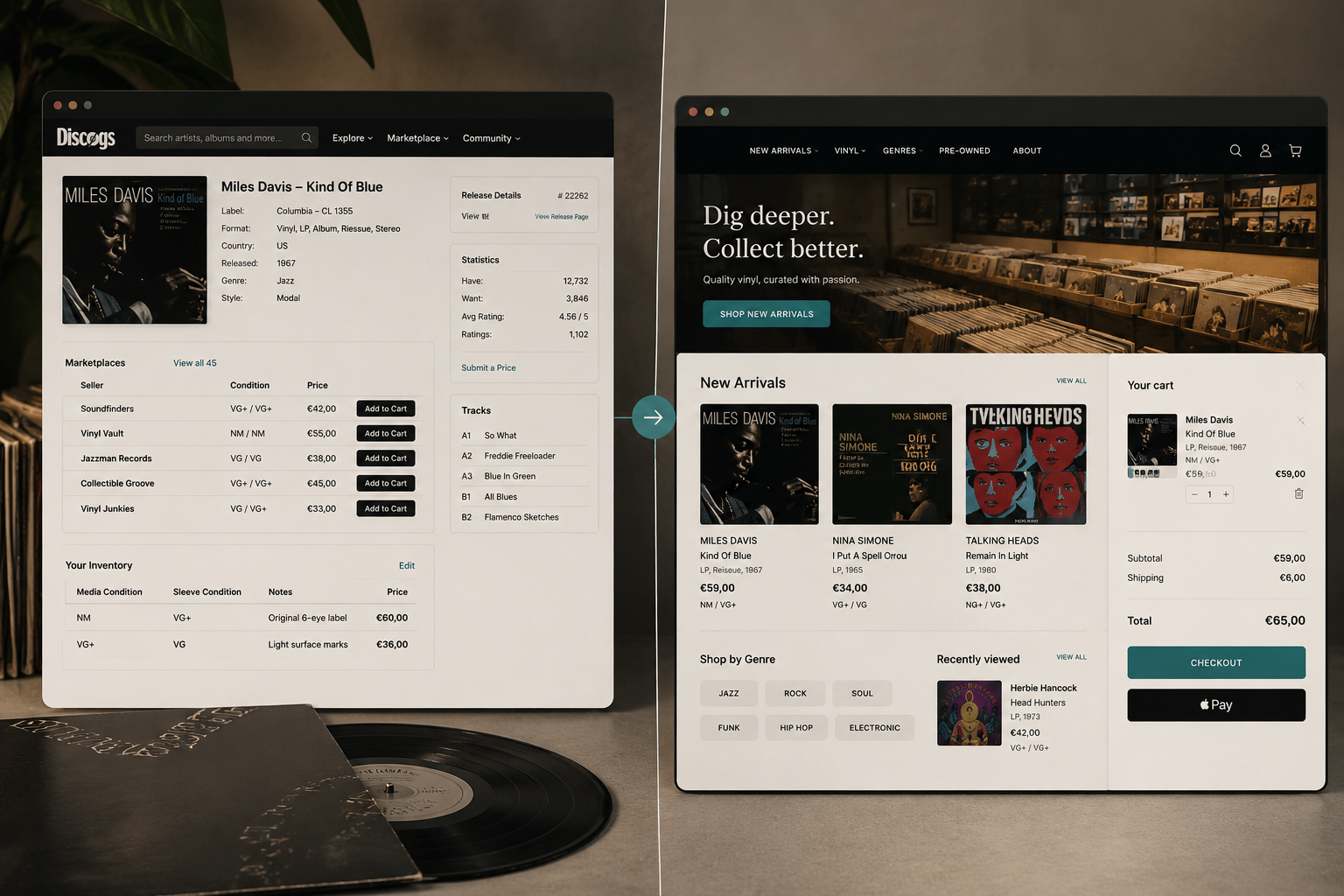
Why Discogs is still valuable
Discogs remains one of the most important platforms for record stores because it is built around music collectors and vinyl buyers. It gives stores access to a marketplace audience, a detailed catalog structure, and a way to list products that are often unique or used.
For many shops, Discogs is still the place where they:
Track used inventory.
Reference pricing.
Reach collectors.
Move niche stock.
Keep a record of what is available.
So this is not about replacing Discogs. It is about using it in a way that does not limit the store’s own brand and growth.
Where the workflow gets messy
The challenge starts when a store is selling in multiple places at once. If stock is on Discogs, in the physical shop, and on a separate website, it can become hard to know what is actually available.
That creates common problems:
Duplicate listings.
Sold items that are not updated fast enough.
Manual stock changes across different platforms.
Inconsistent product descriptions.
Too much time spent on admin instead of selling.
For a small team, this can become a real drain.
Why Shopify helps
Shopify gives the store a stronger owned storefront. Instead of sending customers into a marketplace-style environment, it gives them a branded shop that feels like part of the store itself.
That matters because Shopify lets you:
Control the design.
Present the brand properly.
Run promotions and seasonal campaigns.
Build community around your store.
Create a better mobile experience.
Make the online shop feel like an extension of the physical store.
In practice, Shopify can become the main front door for customers while Discogs stays useful in the background.
A simple way to think about it
A helpful way to structure the workflow is this:
Discogs = catalog visibility, collector reach, marketplace activity.
Shopify = owned brand, customer experience, promotions, and direct online sales.
That does not mean every product has to live in both places in exactly the same way. But it does mean the store should decide which platform is primary and which one supports the bigger strategy.
A better workflow
A record store does not need to make the process more complicated than it has to be. The goal is to reduce manual work and create a system that fits how the shop actually operates.
A simple workflow might look like this:
Use Discogs to manage or reference used stock.
Use Shopify as the branded online store.
Keep product naming and categories consistent.
Update sold items as quickly as possible.
Use Shopify for promotions, campaigns, and customer communication.
The point is not perfection. The point is clarity.
Common mistakes
The biggest mistake is trying to treat every channel separately.
If the store uses Discogs like one business, Shopify like another business, and the physical shop like a third business, the result is usually confusion. Inventory gets harder to trust, and the online experience feels fragmented.
Other mistakes include:
Not deciding which platform is primary.
Overcomplicating the catalog structure.
Leaving used stock inconsistent across channels.
Ignoring the customer-facing brand experience.
Spending too much time on manual updates.
Why this matters for growth
If a record store wants to grow online, the customer experience matters as much as the inventory itself. Discogs is strong for collectors, but Shopify gives the store more control over how it presents itself to the world.
That makes it easier to:
Sell outside the collector bubble.
Promote events and special drops.
Build repeat customers.
Improve conversion on mobile.
Grow the store’s own audience.
For stores that want more than just marketplace sales, that matters a lot.
My recommendation
For most record stores, I would not try to build the entire business around Discogs alone.
I would use Discogs where it is strong, but I would make Shopify the main branded storefront for online customers. That gives the store more room to build a direct relationship with buyers and to create a more professional long-term presence.
If the workflow is messy now, the first step is not adding more tools. It is simplifying the structure so each platform has a clear role.
Final thought
Discogs and Shopify do not have to compete with each other. Used well, they can support different parts of the same record-store business.
Discogs can help with catalog depth and collector reach. Shopify can help with brand, control, promotions, and customer experience. For stores that want to grow beyond a marketplace presence, that combination is often the most practical path.
If your record store is struggling with Discogs, stock sync, or a fragmented online setup, we can help you review the workflow and show you how to simplify it.
PRYMAL Digital
Shopify webshops built for record stores.
Built for discovery, collectors, and modern vinyl commerce.