

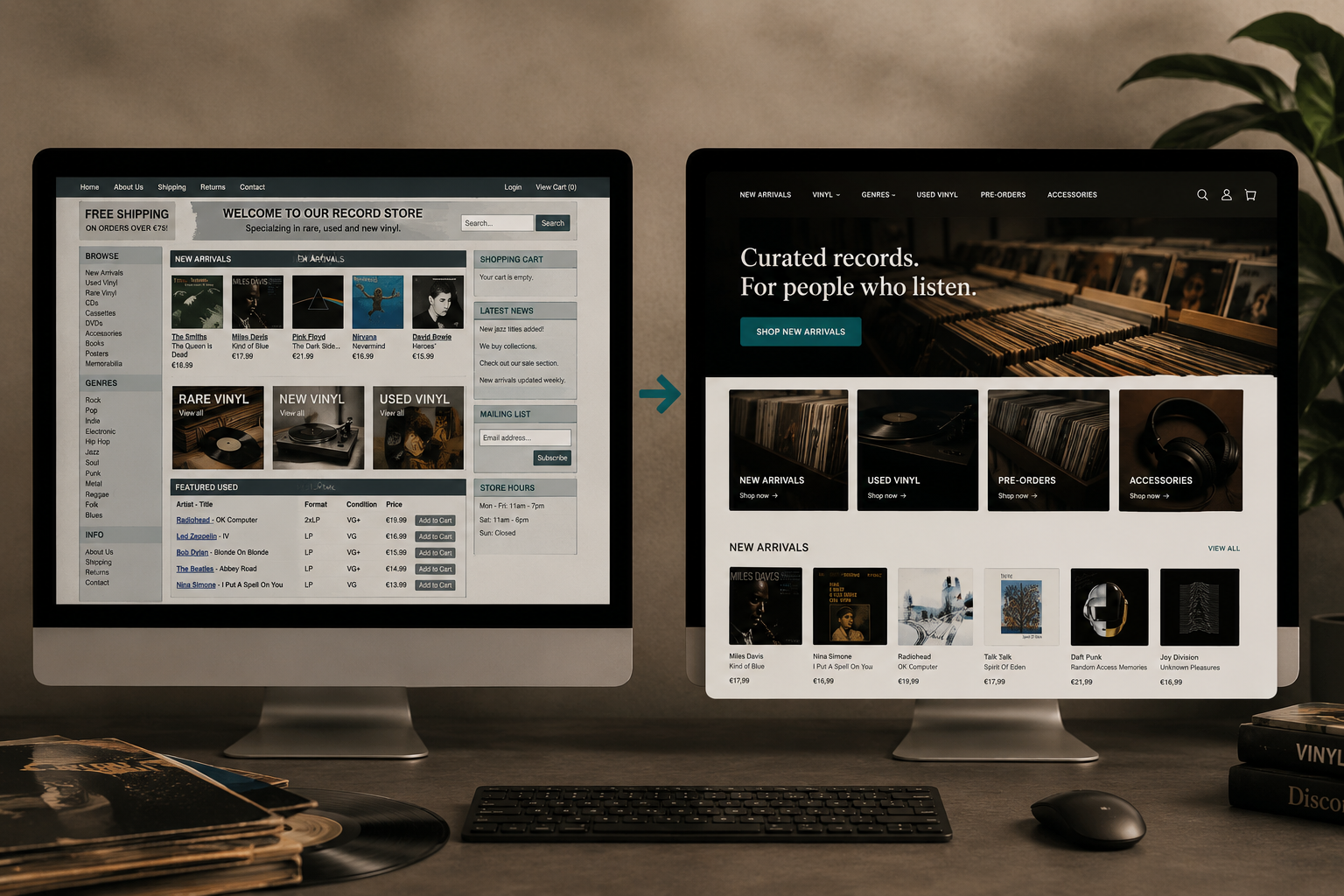
Why Most Record Store Websites Feel Broken
Many record store websites feel broken because of weak navigation, poor mobile usability, cluttered layouts, and confusing product discovery. Here’s what to fix first.
A lot of record store websites are not technically “bad.” They often have the right products, the right name, and a real business behind them. But when you actually try to browse them, they feel broken.
That feeling usually comes from a mix of weak navigation, cluttered product pages, poor mobile usability, and a lack of clear structure. The store itself may be great, but the website does not make that clear.
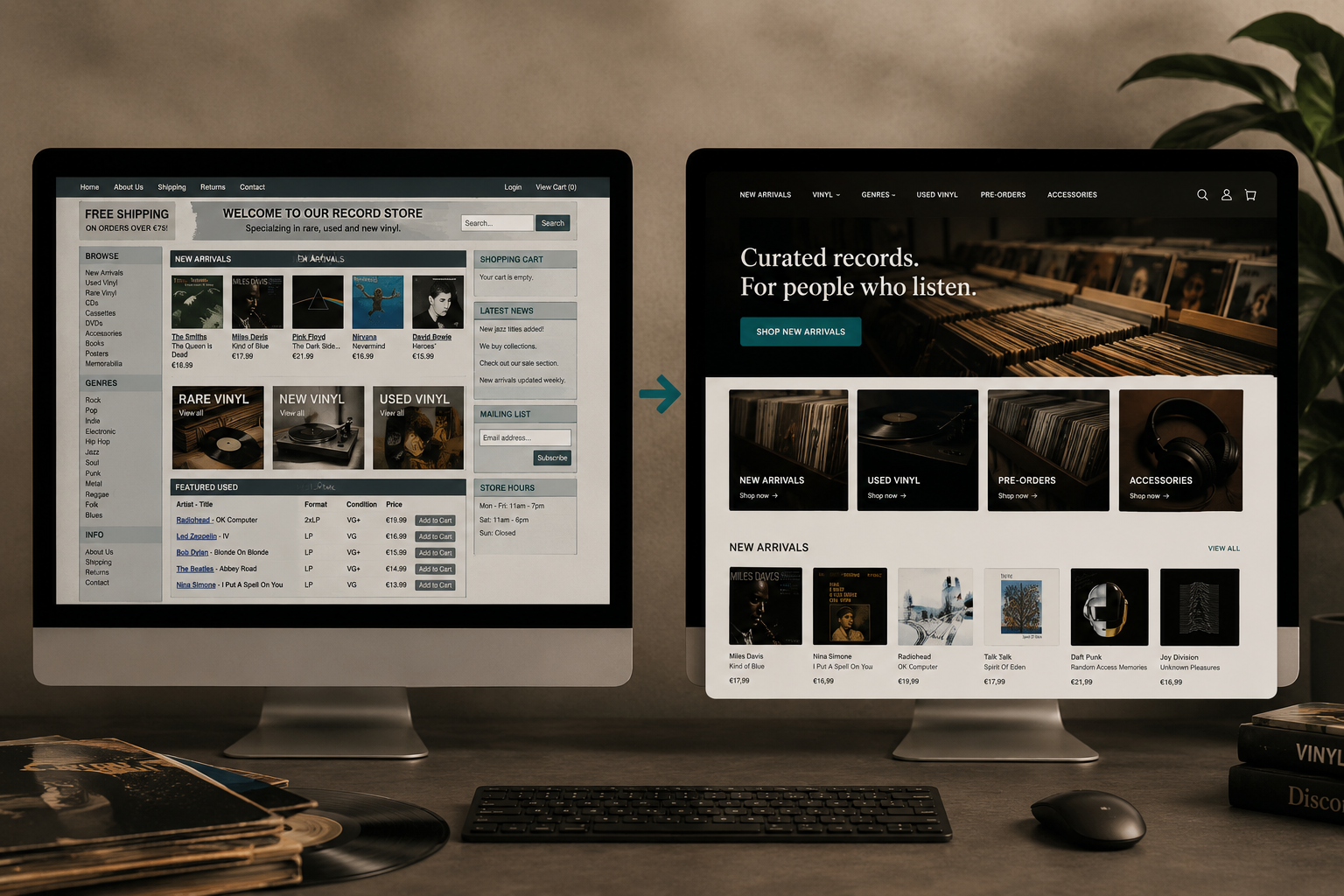
What “broken” really means
When people say a site feels broken, they usually do not mean it literally crashes. They mean the site is hard to understand, hard to browse, or hard to trust.
For record stores, that often shows up as:
Confusing menus.
Too many clicks to get anywhere useful.
Weak search or filtering.
Poor image quality.
Product pages that feel messy.
A layout that does not guide the eye.
If a customer has to work too hard, the site starts to feel broken even if everything technically functions.
Why this happens so often
Record store websites often grow organically over time. A store starts small, adds products, adds pages, adds promotions, and eventually the website becomes a collection of layers rather than a clear system.
That is why the site may feel like it has been patched together instead of designed as a whole. The problem is usually not the records. The problem is the structure.
Common signs of a broken-feeling site
The most common signs are:
The homepage does not clearly explain the store.
The menu is cluttered or inconsistent.
Categories are too broad or too deep.
Product pages are hard to skim.
Condition, price, and availability are not immediately clear.
The mobile version feels cramped or awkward.
There is no obvious path from browsing to buying.
Even one or two of these problems can create friction. When several happen together, the whole site feels unreliable.
Why this matters for vinyl buyers
Vinyl buyers are often browsing with purpose. They may be looking for a specific artist, genre, pressing, label, or condition. They do not want to fight the interface to find it.
If the website feels broken, the store loses momentum immediately. That matters because record buyers are usually comparing multiple options, and the easiest site to use often wins.
The hidden business cost
A broken-feeling website does more than frustrate visitors. It also weakens trust.
If the store’s website feels disorganized, customers may assume:
the inventory is messy,
the stock is outdated,
the store is not active,
or the buying process will be difficult.
That is a big problem, because the website is often the first impression. A weak first impression can quietly reduce sales even when the products are strong.
What a better site feels like
A better record store website does not need to be flashy. It needs to feel clear.
A good site should make the visitor feel:
oriented right away,
confident in the store,
able to browse without friction,
and guided toward the right product or category.
That usually comes from simple structure, clean hierarchy, strong images, and a clear path through the catalog.
Where Shopify helps
Shopify is often a strong foundation for fixing this kind of problem because it gives the store a more structured starting point. That does not mean every Shopify site is good automatically, but it does make it easier to build a cleaner, more intentional experience.
For record stores that want clearer navigation, better product presentation, and a more polished buying journey, Shopify is often easier to shape into something that feels coherent.
What to fix first
If a record store website feels broken, I would start with these priorities:
Simplify the navigation.
Improve the homepage hierarchy.
Make categories easier to understand.
Strengthen product images and product pages.
Make condition, price, and availability easier to scan.
Improve the mobile experience.
Reduce clutter and unnecessary blocks.
Create a clearer path to checkout.
These changes do not all require a full rebuild, but they can dramatically improve how the site feels.
Final thought
Most record store websites do not feel broken because the store is bad. They feel broken because the digital experience has not kept up with the quality of the business itself.
That is actually a good thing, because it means the problem is usually fixable. A more structured, cleaner website can make the store feel more trustworthy, more modern, and much easier to buy from.
If your record store website feels broken or hard to use, we can review it and show you what to fix first.
PRYMAL Digital
Shopify webshops built for record stores.
Built for discovery, collectors, and modern vinyl commerce.
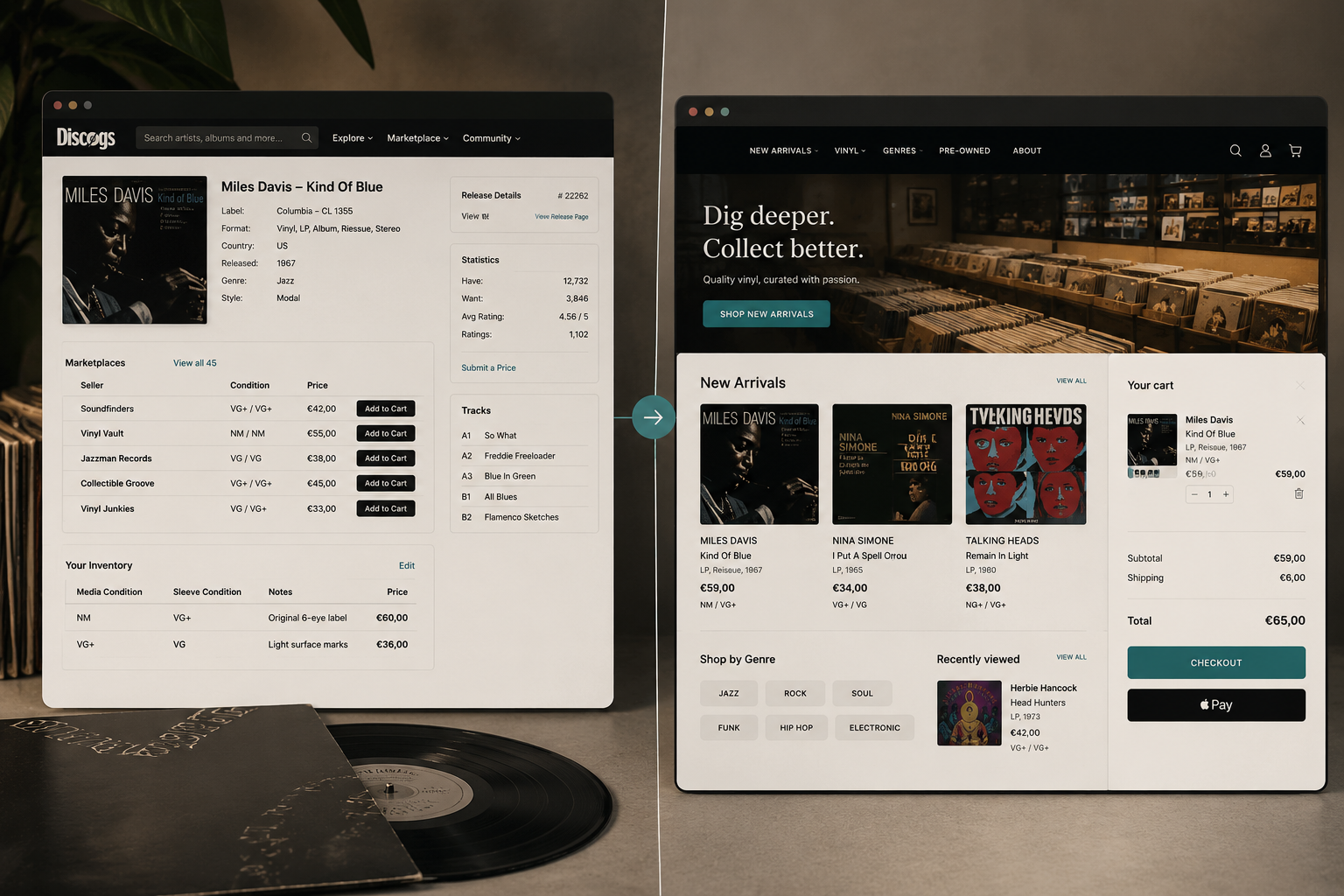
Discogs to Shopify: How Record Stores Can Sync Inventory Better
Learn how record stores can connect Discogs and Shopify more effectively, reduce manual work, and create a smoother inventory workflow.
Many record stores already use Discogs in some way. It is useful for listing used stock, checking market prices, and reaching collectors who already spend time on the platform.
The problem is that Discogs usually does not solve the whole online sales workflow. Once a store also wants a branded storefront, better promotions, and a smoother customer experience, things can get messy fast. That is where Shopify becomes useful.
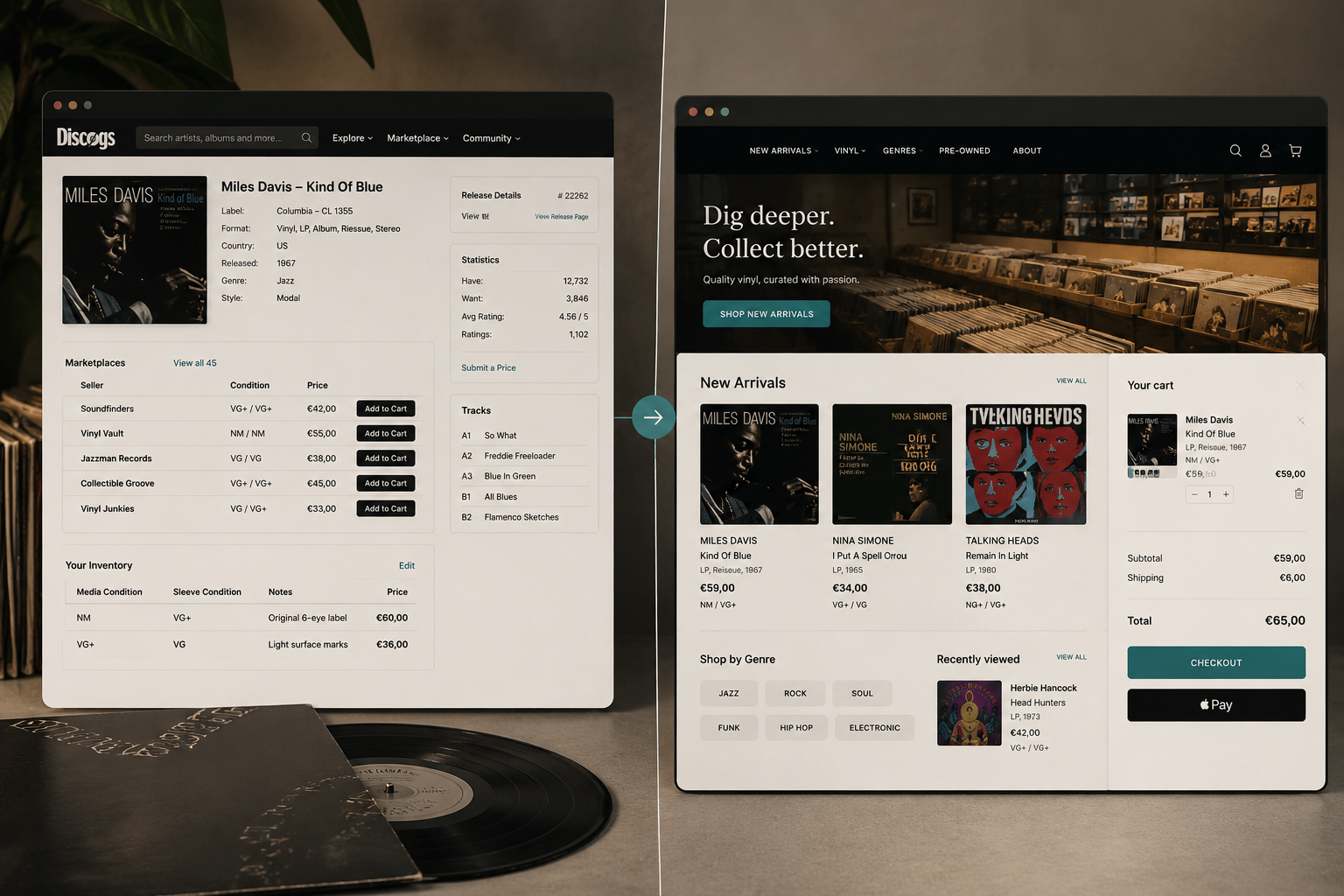
Why Discogs is still valuable
Discogs remains one of the most important platforms for record stores because it is built around music collectors and vinyl buyers. It gives stores access to a marketplace audience, a detailed catalog structure, and a way to list products that are often unique or used.
For many shops, Discogs is still the place where they:
Track used inventory.
Reference pricing.
Reach collectors.
Move niche stock.
Keep a record of what is available.
So this is not about replacing Discogs. It is about using it in a way that does not limit the store’s own brand and growth.
Where the workflow gets messy
The challenge starts when a store is selling in multiple places at once. If stock is on Discogs, in the physical shop, and on a separate website, it can become hard to know what is actually available.
That creates common problems:
Duplicate listings.
Sold items that are not updated fast enough.
Manual stock changes across different platforms.
Inconsistent product descriptions.
Too much time spent on admin instead of selling.
For a small team, this can become a real drain.
Why Shopify helps
Shopify gives the store a stronger owned storefront. Instead of sending customers into a marketplace-style environment, it gives them a branded shop that feels like part of the store itself.
That matters because Shopify lets you:
Control the design.
Present the brand properly.
Run promotions and seasonal campaigns.
Build community around your store.
Create a better mobile experience.
Make the online shop feel like an extension of the physical store.
In practice, Shopify can become the main front door for customers while Discogs stays useful in the background.
A simple way to think about it
A helpful way to structure the workflow is this:
Discogs = catalog visibility, collector reach, marketplace activity.
Shopify = owned brand, customer experience, promotions, and direct online sales.
That does not mean every product has to live in both places in exactly the same way. But it does mean the store should decide which platform is primary and which one supports the bigger strategy.
A better workflow
A record store does not need to make the process more complicated than it has to be. The goal is to reduce manual work and create a system that fits how the shop actually operates.
A simple workflow might look like this:
Use Discogs to manage or reference used stock.
Use Shopify as the branded online store.
Keep product naming and categories consistent.
Update sold items as quickly as possible.
Use Shopify for promotions, campaigns, and customer communication.
The point is not perfection. The point is clarity.
Common mistakes
The biggest mistake is trying to treat every channel separately.
If the store uses Discogs like one business, Shopify like another business, and the physical shop like a third business, the result is usually confusion. Inventory gets harder to trust, and the online experience feels fragmented.
Other mistakes include:
Not deciding which platform is primary.
Overcomplicating the catalog structure.
Leaving used stock inconsistent across channels.
Ignoring the customer-facing brand experience.
Spending too much time on manual updates.
Why this matters for growth
If a record store wants to grow online, the customer experience matters as much as the inventory itself. Discogs is strong for collectors, but Shopify gives the store more control over how it presents itself to the world.
That makes it easier to:
Sell outside the collector bubble.
Promote events and special drops.
Build repeat customers.
Improve conversion on mobile.
Grow the store’s own audience.
For stores that want more than just marketplace sales, that matters a lot.
My recommendation
For most record stores, I would not try to build the entire business around Discogs alone.
I would use Discogs where it is strong, but I would make Shopify the main branded storefront for online customers. That gives the store more room to build a direct relationship with buyers and to create a more professional long-term presence.
If the workflow is messy now, the first step is not adding more tools. It is simplifying the structure so each platform has a clear role.
Final thought
Discogs and Shopify do not have to compete with each other. Used well, they can support different parts of the same record-store business.
Discogs can help with catalog depth and collector reach. Shopify can help with brand, control, promotions, and customer experience. For stores that want to grow beyond a marketplace presence, that combination is often the most practical path.
If your record store is struggling with Discogs, stock sync, or a fragmented online setup, we can help you review the workflow and show you how to simplify it.
PRYMAL Digital
Shopify webshops built for record stores.
Built for discovery, collectors, and modern vinyl commerce.
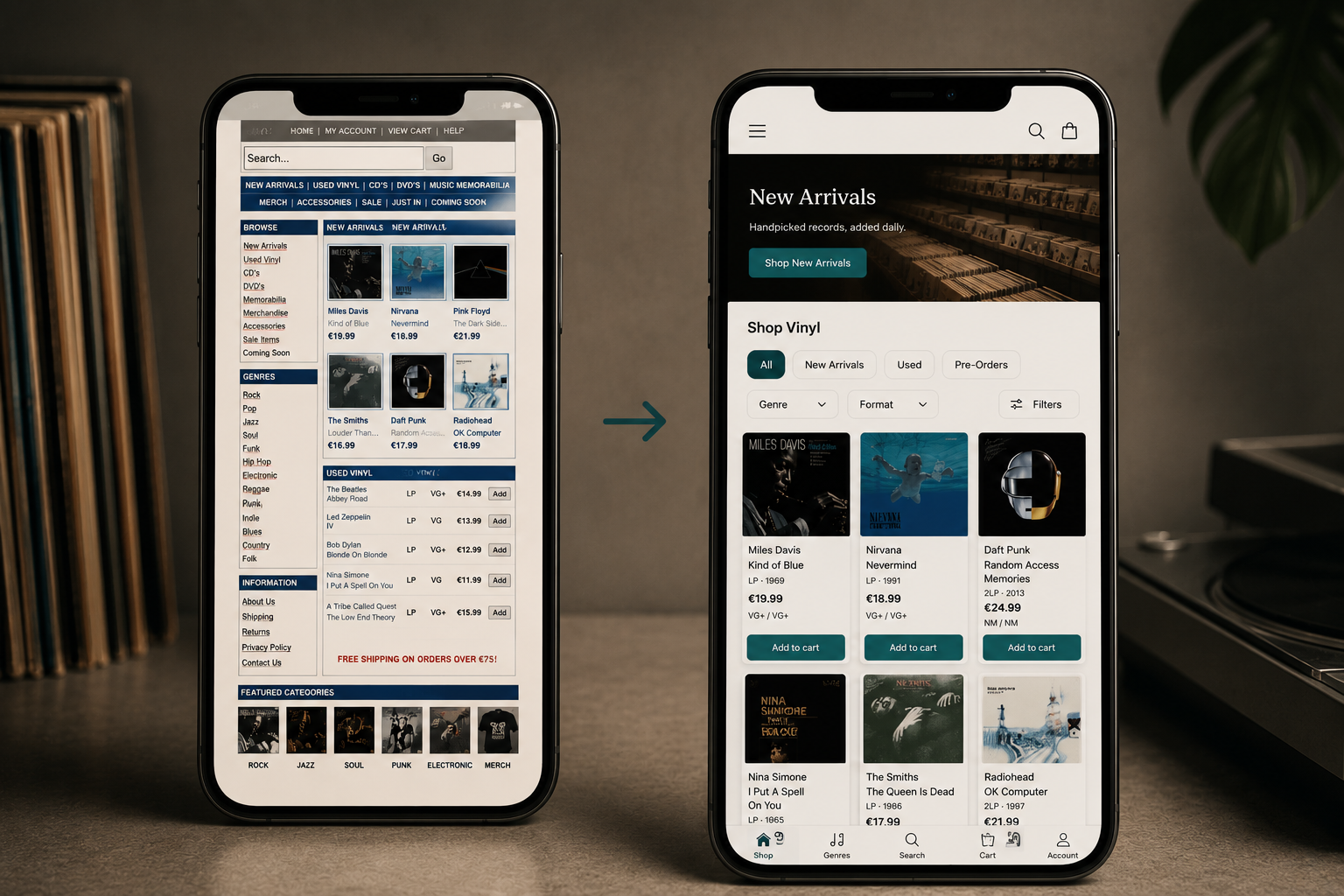
Why Record Store Websites Lose Sales on Mobile
Many record store websites lose sales on mobile because of poor navigation, weak product pages, slow browsing, and cluttered layouts. Here’s how to fix it.
A lot of record store owners think their website is “fine” because it looks good on a laptop. The problem is that most people now browse on their phone first, and that is often where sales are quietly being lost.
For record stores, mobile matters even more because customers are usually checking stock, browsing genres, comparing prices, or trying to find a specific release quickly. If that experience is frustrating, they leave.
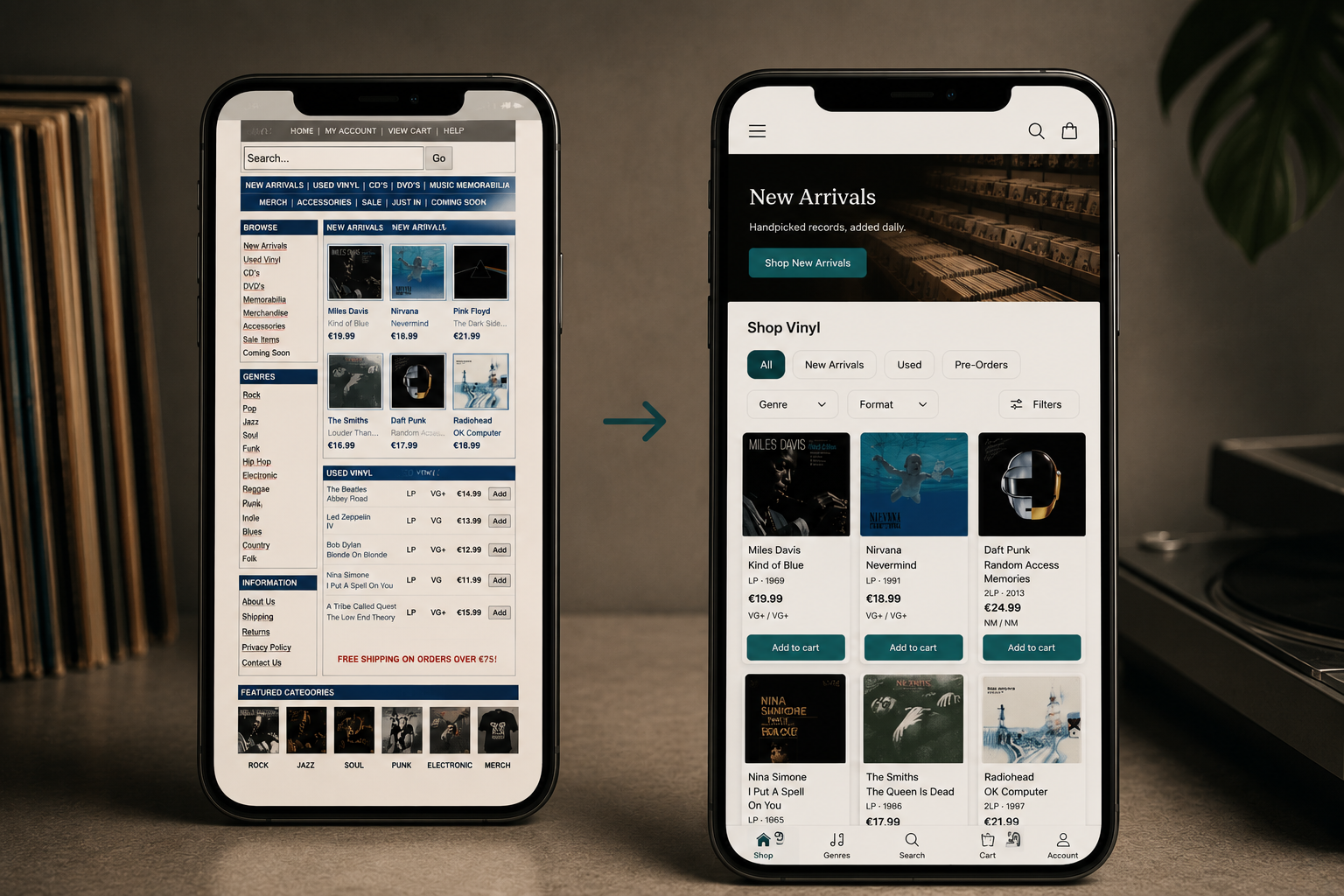
Why mobile matters
Mobile is usually the first touchpoint for a customer who is not already inside your world. They may come from Instagram, a search result, a shared link, or a direct recommendation.
That means the phone experience has to do three things well:
Make the store easy to browse.
Make the brand feel trustworthy.
Make it simple to buy.
If any of those fail, the store loses momentum before the customer even gets to the product.
Common mobile problems
A lot of record store websites lose sales for very simple reasons. The most common problems are:
Menus that are hard to use on a phone.
Product images that are too small.
Filters that are missing or buried.
Too much text on product pages.
Slow loading times.
Checkout that feels awkward or crowded.
Buttons that are too close together.
None of these problems sound dramatic on their own. But together, they create friction that quietly kills conversions.
Why this hurts record stores especially
Record store customers often browse in a more specific way than general shoppers. They want to move between genres, labels, conditions, formats, and rare items quickly.
That means if the mobile site is clumsy, the customer feels it immediately. They do not want to dig through a long page or tap through a confusing menu just to see if a record is available.
This is especially true for used vinyl, where browsing speed and trust matter a lot.
What a better mobile store looks like
A better mobile record store website usually feels very simple. The customer should be able to:
Open the site and understand it quickly.
Search or filter without friction.
Tap into products easily.
See clear images and pricing.
Check out without confusion.
The best mobile experience does not try to do too much at once. It just removes friction.
Where Shopify helps
Shopify is often a strong foundation for this because it gives you a clean, flexible structure for a mobile-friendly storefront. That does not mean every Shopify store is automatically good on mobile, but it does mean the platform gives you the right base if the design is handled properly.
For record stores that want better browsing, stronger product presentation, and a cleaner mobile path to purchase, Shopify is often easier to shape into the right experience.
Practical fixes
If you want to improve a record store website on mobile, start with these changes:
Simplify the main navigation.
Make the search bar easy to find.
Use larger product images.
Add clear filters for genre, artist, label, format, and condition.
Shorten product descriptions at the top.
Make buttons bigger and easier to tap.
Reduce clutter on category pages.
Test the full checkout flow on a phone.
A lot of these improvements are not glamorous, but they are exactly what help the store sell more.
A quick self-check
If you want to know whether your mobile site is good enough, ask yourself this:
Can someone land on the site, understand what you sell, find what they want, and buy it in less than a minute without getting frustrated?
If the answer is no, there is probably money being lost.
Why this matters for growth
A better mobile site does more than improve user experience. It also supports Instagram traffic, search traffic, and repeat customers.
That is important because a lot of record-store discovery now happens outside the store itself. If people click through from social media or search and the site feels weak on mobile, the opportunity is gone.
In other words, mobile is not a small detail. It is part of the sales system.
My recommendation
If a record store wants faster wins, I would always start with the mobile experience.
It is often easier to improve than the whole business model, and it usually reveals clear problems very quickly. Fixing mobile issues can create a noticeable lift in trust and conversion without requiring a full rebuild.
If a store is already decent on desktop but underperforming online, mobile is one of the first places I would look.
Final thought
A lot of record store websites do not lose sales because the products are wrong. They lose sales because the phone experience is too hard to use.
That is good news, because it means the problem is often fixable. A cleaner mobile experience can make the store feel more modern, more trustworthy, and much easier to buy from.
If your record store website feels weak on mobile, we can review it and show you what to improve first.
PRYMAL Digital
Shopify webshops built for record stores.
Built for discovery, collectors, and modern vinyl commerce.
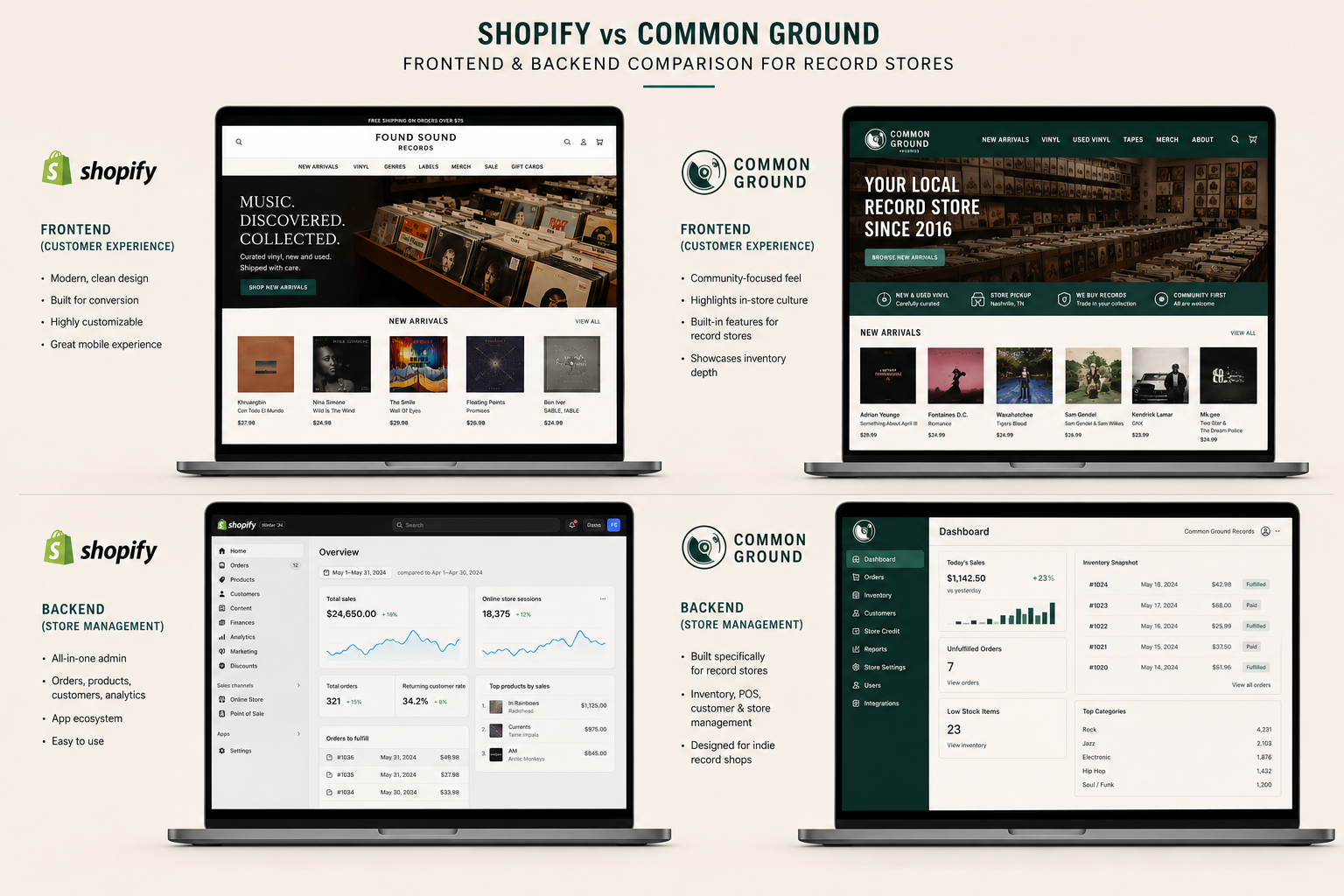
Shopify vs Common Ground for Record Stores
A practical comparison of Shopify and Common Ground for record stores, including flexibility, inventory control, mobile experience, and which platform suits your shop best.
If you run a record store, choosing the right platform is one of the most important decisions you can make. It affects how easily customers browse your catalog, how smooth your mobile experience is, how you manage inventory, and how much control you keep over your brand.
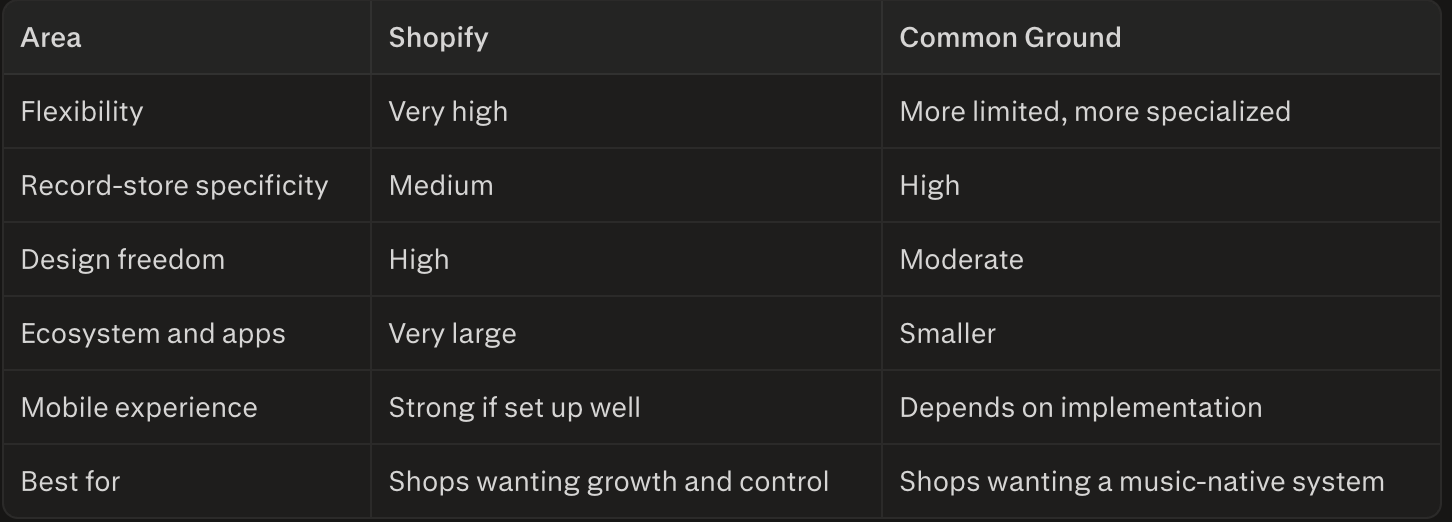
The short version is this: Shopify is often the better choice for record stores that want long-term flexibility, a polished storefront, and a platform they can grow with. Common Ground is interesting for shops that want a music-specific system, but Shopify gives most stores more room to build a stronger business over time.
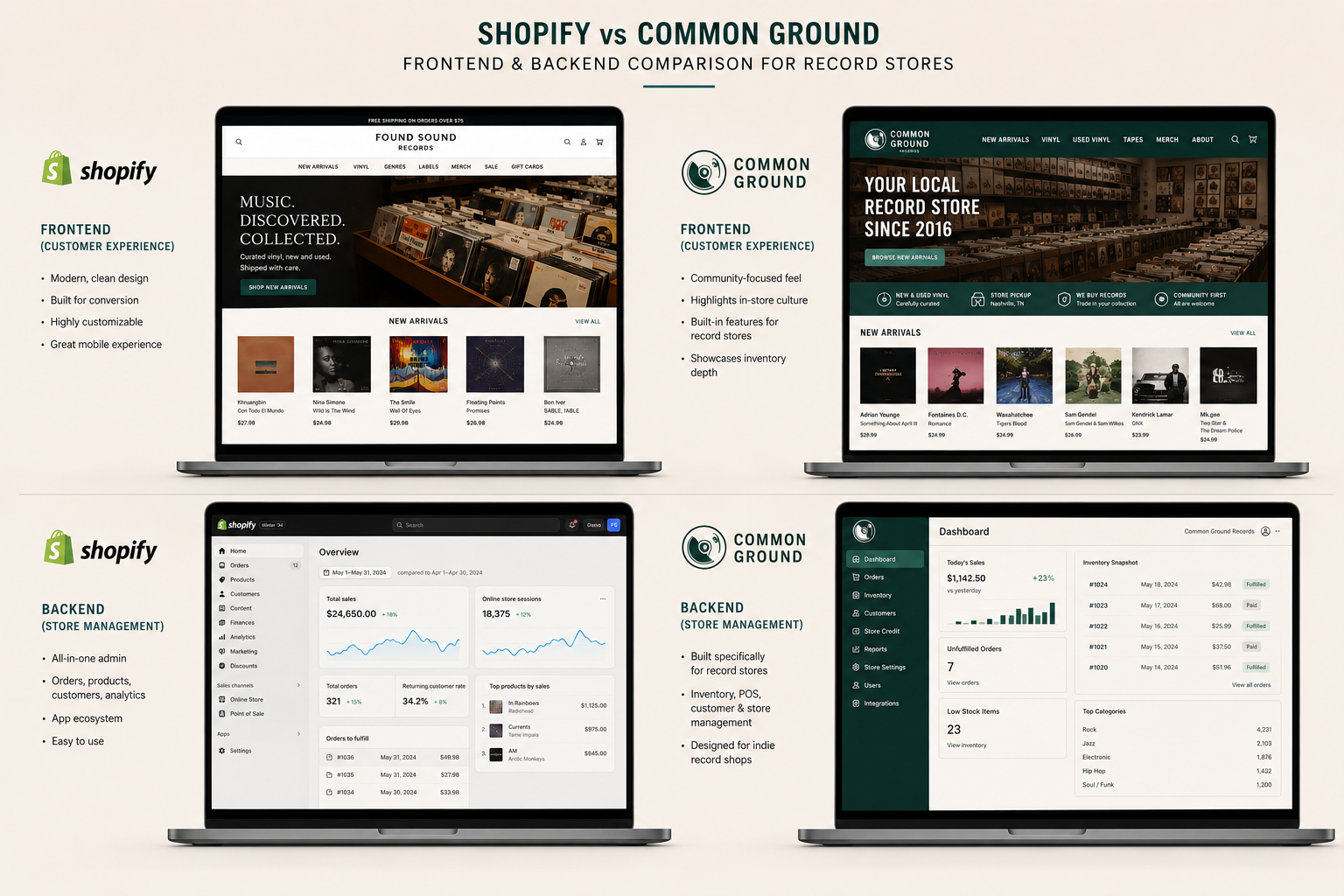
Why this comparison matters
Record stores are not normal ecommerce businesses. You often deal with used stock, grading, one-off items, Discogs workflows, in-store and online sales at the same time, and customers who care about browsing by genre, condition, rarity, and format.
That means the platform should not just look nice. It should help you handle real operational complexity without creating more manual work.
Shopify in practice
Shopify is the strongest all-round option for many record stores because it gives you a polished storefront, strong mobile performance, a large ecosystem of apps, and full control over design.
It is especially useful if you want to:
Build a stronger brand around your shop.
Create a better customer experience.
Improve mobile conversion.
Connect multiple tools and workflows.
Grow beyond a basic ecommerce setup.
In practice, Shopify is often the platform that gives store owners the most options later, even if it takes a bit more setup at the start.
Common Ground in practice
Common Ground is more niche and music-focused. That can be a real advantage if you want a system designed around record-store logic rather than a broad ecommerce platform.
It is especially appealing if you care about:
Music-retail workflows.
A system built specifically for record shops.
Less need to stitch together separate tools.
A setup that feels closer to your industry.
The downside is that a niche platform can be more limited in flexibility, branding freedom, or broader ecommerce customization compared with Shopify.
POS and in-store sales
Both Shopify and Common Ground support POS and in-store selling. The real difference is not whether POS exists, but how the platform fits the rest of the store’s workflow, branding, and long-term growth strategy.
Price comparison
Cost is one of the biggest differences between the platforms.
Common Ground presents itself as an all-in-one record-store platform with an Essentials plan starting at $30/month and no platform fees. Shopify’s base plans are also affordable, but the total cost can increase once you add apps, themes, payment processing, or custom setup.
For many record stores, that is not really a downside — it is the price of getting a platform that can be shaped more precisely to the brand and the customer experience.
Which one is better?
For most record stores, I would say Shopify is the better default choice.
Why? Because most shops eventually want:
better branding,
stronger online sales,
easier marketing,
more control over the site,
and a platform that can evolve with them.
Common Ground makes sense if a store wants a very specific record-store workflow and is happy with a narrower system. But if you are trying to build a serious long-term ecommerce presence, Shopify usually gives you more room to grow.
When Common Ground is the better choice
Common Ground can be a strong option if the store:
has a very music-specific operation,
wants a tightly focused system,
does not need extensive customization,
and prefers a platform built around the record-store business model.
In other words, it can work well for stores that want simplicity and niche alignment over flexibility.
When Shopify is the better choice
Shopify is the better choice if the store:
wants a better-looking storefront,
needs more conversion potential,
wants to sell internationally,
needs more control over design,
or wants to build a real brand instead of just a functional shop.
It is also usually the better option if you want the site to support content, SEO, and future marketing efforts.
My recommendation for record stores
If I were advising a record store owner, I would usually start with Shopify.
Why? Because most shops eventually want:
better branding,
stronger online sales,
easier marketing,
more control over the site,
and a platform that can evolve with them.
Common Ground is worth considering when a shop wants a very specific record-store workflow and prefers a narrower system. But for most stores that want room to grow, Shopify is the more future-proof choice.
Final thought
This is not really a battle between two equal options. It is a choice between flexibility and specialization. For many record stores, Shopify wins because it can be shaped into a strong, modern, branded sales system. Common Ground wins when the shop wants a more focused record-store environment and less general ecommerce complexity.
If your record store is on the wrong platform, or your current setup feels outdated, we can help you review it and show you what to improve first.
PRYMAL Digital
Shopify webshops built for record stores.
Built for discovery, collectors, and modern vinyl commerce.